I realized that much of my efforts to make the history center better for the visually impaired seemed to be coming back to the app i made in my first internship. The initial idea of having objects that visually impaired people could hold or virtually interact with was noble and novel but I would have been missing out on ways to help them before they even got to the objects. The money involved in constantly 3d printing replicas or maintaining haptic feedback gloves would have been too much to continue with on a yearly basis and after the passing of Amendment 3, even more so.
I still intend to 3d print an item as proof of concept but it will only be that, a proof of concept. To get the object to look the same would be very difficult. Each scratch, dent, or purposeful mark on the object would need to be added to bring about the sense that the person was holding or viewing the real thing. In cases where something has been inscribed with initials this would be very important and difficult on a 3d printer, especially the depth of the inscription. This is not even mentioning the aspect of general coloring. Something with a distinctive pattern like a tea cup would need to be colored inside and outside the cup and that would be very hard to do. What would end up happening is that we would hand the person who is visually impaired a single plastic colored object.
This brought me to the idea of the VR objects and the haptic feedback gloves. By scanning an object you get every scratch and color shift. The gloves are the most expensive part and while they are very cool to use they essentially just allow you to move an object around to view it.
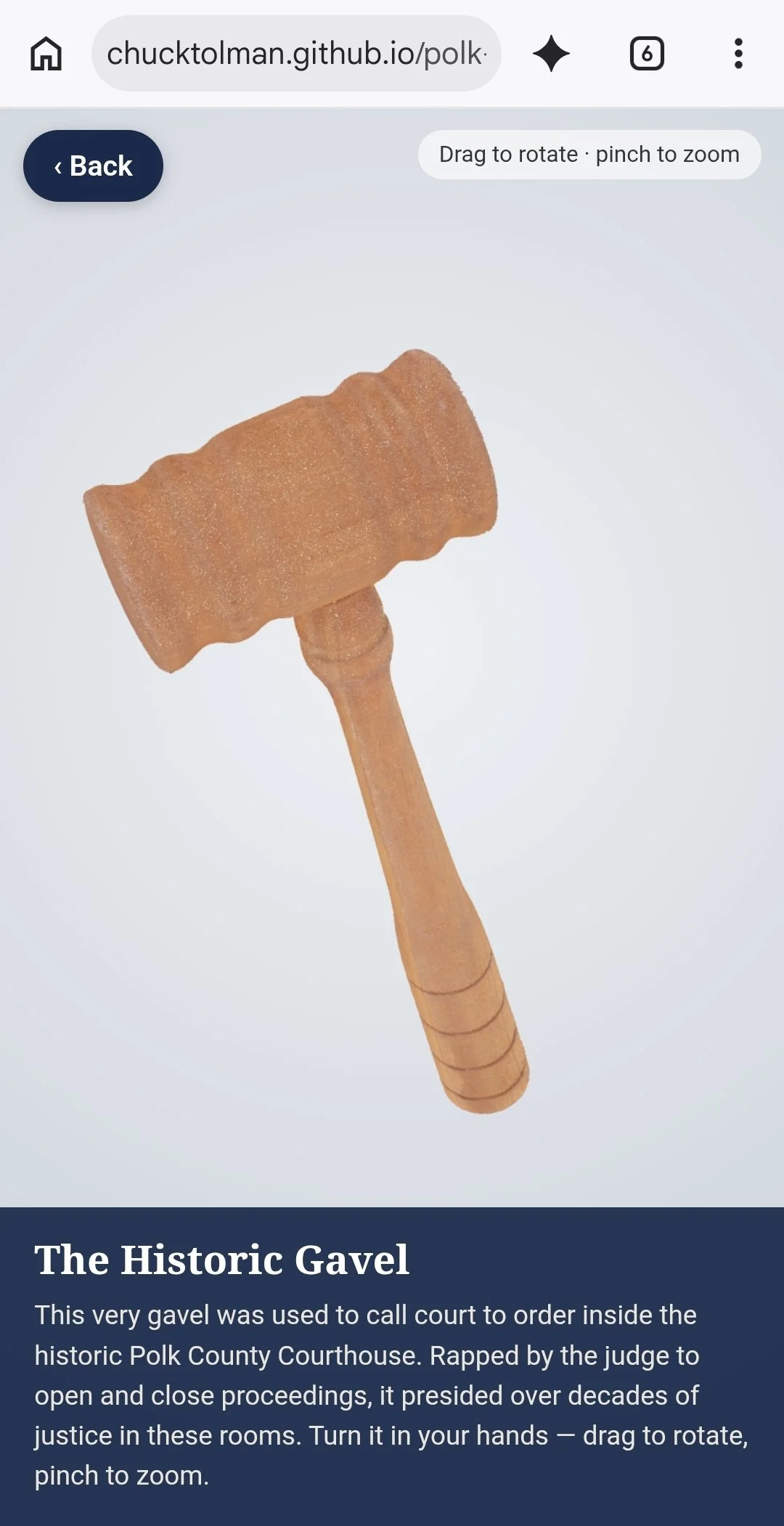
I figured out a way to incorporate this feature in the app. A woman named Jameez Lawes had come to the museum to do photogrammetry and I was put into contact with her in hopes we could get something to 3d print. After talking with her over Zoom, I figured out how to incorporate her work into mine. The file she had wasn’t a 3d printing file, as I was told, but was a .psx file which was for photos. She had taken dozens of photos of a gavel from the courthouse and used a software to assemble them into a 3d object. I took her file and converted it into another type and then converted that into a .glb file which I know my app can display. I incorporated her gavel, which was used in the court room in the history center into the section on courtroom experiences.
Now guests can see the gavel in 3d and manipulate it in all directions and zoom in as close as possible to see every grain of wood and scratch. The version I have up is very simple but it is a proof of concept. Once we can use proper 3d scanners we can get a better object.
This is the compromise that I had inadvertently been searching for the entire time. In the future, a guest will scan the QR code and take the tour of the museum, being guided with the app and maps with the option for audio, to help those with visual impairments. They will be able to select specific items from the exhibit cases and view them in 3d and zoom into them, so someone who is not able to see the objects in the case very clearly can see the details for as long as they want on their smart device.